Reviewed by Gabriel Ebiere
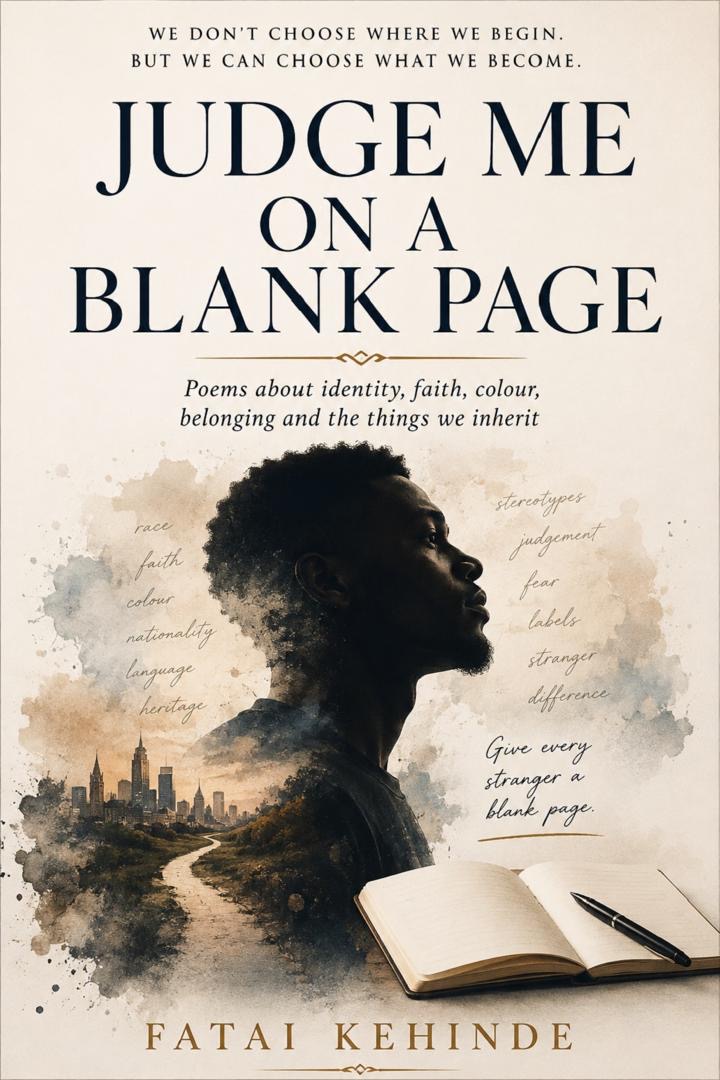
Title: Judge Me on a Blank Page
Author: Fatai Kehinde
The Human Being Beyond the Labels: A Critical Review of Judge Me on a Blank Page
What if the things we use to identify one another are precisely the things preventing us from truly knowing one another? What if nationality, religion, skin colour, accent and cultural background, rather than serving as windows into human experience, have become walls through which we judge people before encountering them? These questions form the intellectual and emotional foundation of Fatai Kehinde’s Judge Me on a Blank Page, a poetry collection that challenges the assumptions through which individuals are categorised, stereotyped and frequently misunderstood.
Through accessible language, reflective questioning and recurring moral appeals, Kehinde examines the relationship between inherited identity and personal responsibility. The collection’s central proposition is straightforward but significant: people should be judged by their character and actions, not by the identities they did not choose or the misconduct of others who share those identities. As the author explains in his opening note, “inheritance is not destiny.” This idea becomes the collection’s guiding principle, connecting its explorations of racism, religious identity, migration, prejudice and intergenerational learning.
Beyond the Accident of Birth
The collection opens with a fundamental consideration of human identity: nobody chooses the circumstances of their birth. In the first section, Before I Chose Anything, Kehinde questions the moral significance people attach to nationality, religion, language and skin colour. Poems such as “The Accident of Birth,” “Born Somewhere” and “If I Had Been Born You” invite readers to consider how differently their identities and convictions might have developed had they been born into different families, societies or geographical locations.
The strength of these poems lies in their ability to transform an abstract philosophical question into an accessible human reflection. By imagining how another person’s upbringing might have shaped their worldview, the poet encourages intellectual humility. His argument is not that identity is meaningless, but that inherited identity should not automatically become a measure of moral worth.
The treatment of religion is particularly thought-provoking. In “The Geography of Belief” and “The Religion I Was Given,” Kehinde considers how geographical location and childhood influence religious familiarity and belief. His suggestion that faith can be shaped by the circumstances into which one is born invites readers to examine the relationship between conviction, upbringing and independent thought.
Importantly, the collection distinguishes between a religion and the behaviour of its adherents. This distinction broadens the discussion beyond any single faith tradition, making the poems relevant to readers navigating religious difference and cultural misunderstanding.
How Prejudice Is Learned
In What They Taught Us, the poet shifts attention from inherited identity to inherited prejudice. “Nobody Is Born Knowing Who to Hate,” “Hate Is an Inheritance” and “The Curriculum of Fear” explore how discriminatory attitudes can develop through family conversations, social conditioning, cultural narratives and unexamined assumptions.
One of the collection’s most compelling observations is that prejudices often survive because people forget they were taught. What begins as another person’s warning can eventually become an unquestioned personal conviction. Through this progression, Kehinde challenges readers to distinguish between beliefs they have thoughtfully examined and assumptions they have merely inherited.
The section’s most constructive contribution, however, is its insistence that learned prejudice can be unlearned. In “You Can Unlearn,” the poet argues that understanding the origins of a belief does not require its continued acceptance. Individuals can respect their families and cultural histories without reproducing every assumption those histories contain.
This is a particularly valuable argument because it moves the discussion beyond condemnation. Rather than simply identifying prejudice as a social problem, Kehinde emphasises the possibility of personal intervention. The individual becomes responsible not only for examining inherited attitudes but also for deciding which attitudes will continue into the next generation.
Race, Representation and the Politics of Perception
The third section, The Colour They Gave Me, addresses racial identity and the meanings society attaches to skin colour. In poems such as “Before I Knew I Was Black,” “The Language of Colour” and “Learning to Love My Reflection,” Kehinde examines how racial categories can influence self-perception and how cultural associations between darkness, danger and evil can reinforce harmful stereotypes.
The poet’s approach combines personal affirmation with social criticism. He rejects the suggestion that Blackness requires justification and challenges the assumption that complexion can reveal character. In “The Mirror They Gave Me,” the mirror becomes a metaphor for society’s distorted representation of marginalised people. The individual may begin to internalise the judgments of others, mistaking an imposed perception for an authentic understanding of the self.
The subsequent section, The Stranger Who Looks Like Me, develops this argument through the problem of collective blame. “The Worst Person Who Looks Like Me” exposes the unequal standards through which individuals sometimes defend their own identities while holding entire racial or national groups responsible for the actions of one member.
Here, the collection makes one of its strongest ethical arguments: accountability should be individual rather than indiscriminately collective. A person’s wrongdoing deserves scrutiny, but resemblance, nationality or religious affiliation does not establish another person’s guilt.
Nevertheless, the argument also raises an important question. Although individual responsibility is indispensable, prejudice is not always reducible to isolated personal attitudes; it can also operate through institutions, policies and established social practices. A more extensive examination of these structural dimensions would have added further complexity to the collection’s otherwise persuasive critique.
Migration and the Experience of Otherness
In The Immigrant, Kehinde draws on his movement between Nigeria, Russia and the United Kingdom to explore the experience of living across national and cultural boundaries. His author’s note establishes migration as an important influence on the book, describing how different environments revealed the ways people respond to those they perceive as outsiders.
The poems “The Man Behind the Passport,” “When an Accent Becomes a Verdict” and “A Passport Cannot Measure a Person” examine the tendency to reduce immigrants to a single label. The poet challenges assumptions about intelligence, competence and trustworthiness based on accent or national origin.
His observation that “difficulty speaking is not difficulty thinking” captures a significant dimension of cross-cultural experience: language proficiency and intellectual ability are not interchangeable. A person may struggle to express an idea in an unfamiliar language without lacking the knowledge or reasoning necessary to understand it.
The section also considers the complexity of belonging. In “Where Exactly Is Home?”, migration becomes more than geographical relocation; it becomes an accumulation of memories, relationships and experiences that complicate the meaning of home.
The collection’s The Bus Seat section makes these concerns tangible through a brief encounter in which a woman moves away from the speaker. The incident becomes an understated representation of everyday racial suspicion. Rather than allowing the encounter to define him, the speaker chooses not to internalise the woman’s prejudice.
This response is emotionally restrained, and that restraint is effective. The poet communicates the persistence of discrimination without relying on dramatic confrontation.
Literary Style, Structure and Critical Limitations
Kehinde organises the collection into eight sections, creating a progression from inherited identity to social conditioning, racial consciousness, collective judgment, migration, personal reflection and, ultimately, individual accountability. The final section, The Blank Page, brings these strands together through poems including “Character,” “Individual” and “Human Before Anything Else.”
The blank page is the collection’s central metaphor. It represents the opportunity to encounter another person without allowing pre-existing stereotypes to determine the outcome. Crucially, the metaphor does not demand historical amnesia. In the title poem, the speaker acknowledges that history and personal experience exist while insisting that neither should automatically dictate the judgment of an individual.
Stylistically, the collection favours free verse, short lines, repetition, direct address and rhetorical questions.
These techniques give the poems clarity and make them accessible to readers who may not ordinarily engage with poetry. The recurring questions also create opportunities for introspection, encouraging readers to participate in the ethical inquiry rather than remain detached observers.
However, the collection’s accessibility comes with certain limitations. Its vocabulary, sentence structures and recurring arguments are deliberately uncomplicated, but the repeated emphasis on judging individuals rather than categories occasionally produces thematic redundancy. Several poems revisit closely related propositions without always developing them through substantially different imagery or perspectives.
Furthermore, the collection frequently favours moral clarity over ambiguity. This strengthens its central message but sometimes leaves complex questions about religion, identity, social power and institutional discrimination insufficiently explored. More varied poetic forms, richer sensory imagery and greater attention to contradictory experiences could have deepened its literary texture.
These limitations do not invalidate the collection’s message. Rather, they identify opportunities for greater artistic and intellectual development in a work whose principal strength is its clarity of purpose.
Final Verdict: An Invitation to Rethink the Stranger
Judge Me on a Blank Page is a reflective collection that asks readers to reconsider the assumptions through which they encounter other people. Its greatest achievement is not the introduction of an entirely new argument about prejudice, but its sustained effort to make that argument personally relevant.
By moving from the circumstances of birth to the consequences of inherited hatred, and from experiences of discrimination to the responsibility of self-examination, Kehinde presents tolerance as more than a public declaration. It becomes a daily practice of questioning assumptions, accepting individual accountability and refusing to reproduce the prejudices one has experienced.
The collection is particularly relevant to readers interested in race, migration, religious identity, multicultural societies and the intergenerational transmission of beliefs. It could also serve as a useful discussion text in schools, reading groups and community conversations about diversity and human relations.
Ultimately, the book leaves readers with a challenge that extends beyond the page: if we expect others to see us as individuals, we must be willing to extend the same consideration to them. Its closing vision is not of a world without history or difference, but of one in which neither becomes an automatic verdict on another human being.
Kehinde’s appeal is both simple and demanding: allow people the dignity of being known before deciding who they are. In a world where assumptions can precede introductions, that remains a worthwhile place to begin.
Bio of reviewer
Gabriel Ebiere Blessing is a Nigerian writer and spoken-word artist whose work interrogates the complexities of human existence, faith, identity, and the delicate intersections between personal experience and collective realities. Her writing is characterised by emotional depth, contemplative inquiry, and a keen sensitivity to the unspoken narratives that shape human lives. Her work reflects a sustained interest in the transformative possibilities of words and their capacity to deepen human understanding.
1