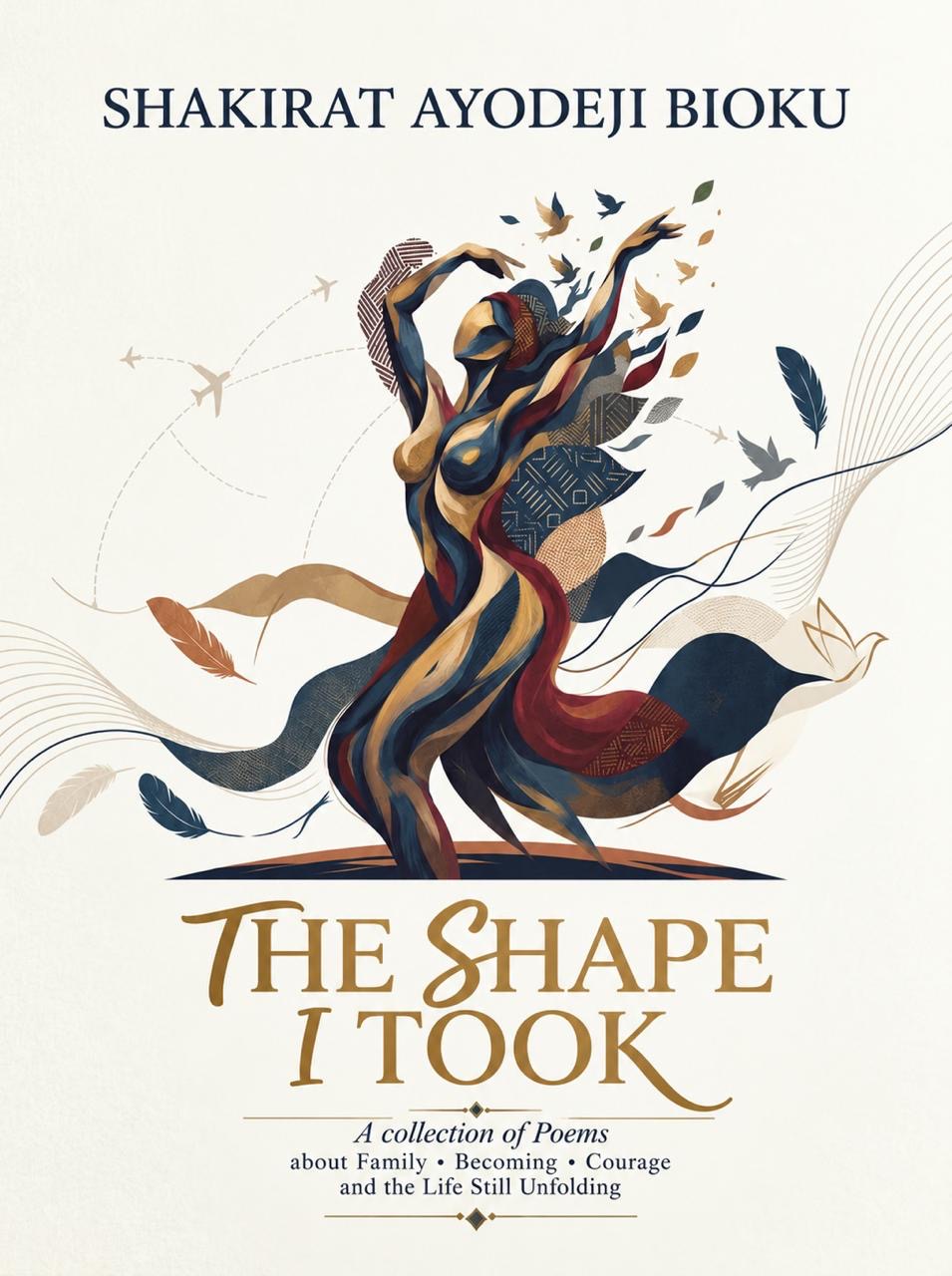
Review by Adeleke Babatunde
Shakirat Bioku’s debut traces the distance between the life that formed her and the one she is still making.
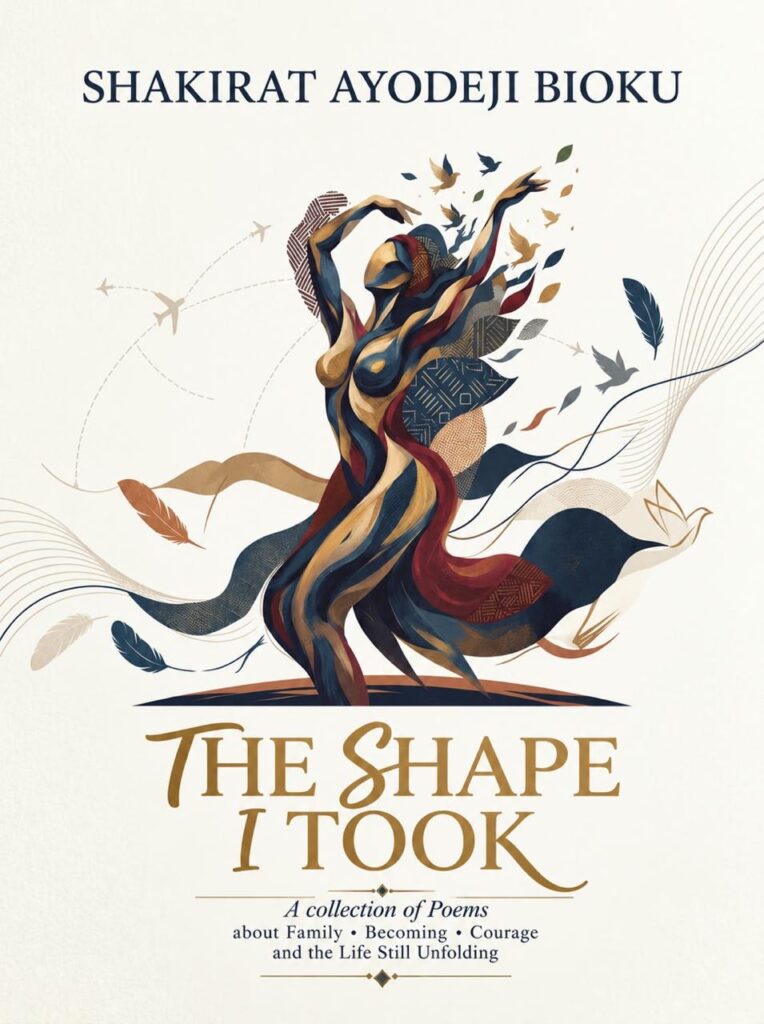
Shakirat Ayodeji Bioku’s first collection, The Shape I Took, announces its concerns in the subtitle: family, becoming, courage, and the life still unfolding. The poems deliver on that promise with a voice that is direct, performance-trained, and largely uninterested in disguise. Bioku, who has worked in theatre, traditional dance, and spoken word in Nigeria and Leeds, writes as someone used to holding a room. The page inherits that clarity. What it does not always inherit is the pressure that turns clarity into something harder to look away from.
The book’s strongest material sits in the family poems. “The House Had Many Doors” opens with a childhood in which love does not sit at one table. There are different rooms, different versions of belonging, and the slow discovery that a family can carry “so many invisible maps.” The poem does not rush to heal the wound. It records the day the father disowned her, then turns, with more force, to the mother’s face. “That is the strange thing / about family pain— / you can be hurt / by what happened to you / and still ache more / watching someone you love / hurt because of it.” The observation is exact. It also sets the collection’s central ethical move: refusing to let the injury become the only story.
“My Mother’s Secret Language” deepens that refusal. For years the speaker believed her mother was giving her away, sending her on trips and errands, making her available to other people’s needs. Only later does she understand the design: a shy child was being taught to enter unfamiliar rooms without shrinking. The poem’s best moment arrives when the mother describes her daughter to a stranger with “uncomfortable accuracy.” The speaker realises she has been read more carefully than she knew. “That was the day / I realized my mother / had been reading / a book I did not know / I had written.” It is one of the few places where the collection trusts an image to carry the argument.
The immigration sequence is almost as strong. In “I Had Already Left,” the speaker waits three years for the chance to leave Nigeria. Documents stall. Plans change. Persistence begins to feel like stubbornness. When the plane finally lifts, the country looks smaller and the dream looks larger, yet arrival is not the climax. “You spend years / asking God for the door, / then walk through it / and discover / the door was never / the destination. / It was the entrance.” The poem resists the tidy success narrative that often attaches itself to stories of leaving. Arrival is only the beginning of another kind of work.
Where the collection weakens is in its appetite for instruction. Too many poems move from a concrete situation into a closing lesson. Resilience is named rather than shown. Courage is declared rather than tested on the page. Lines such as “I did not choose / everything that shaped me. / But I have chosen / what I will become / because of it” are true enough, and they are also the kind of truth that arrives pre-summarised. The performance background helps and hinders here. Bioku knows how to land a line for an audience. On the page, that skill sometimes produces a finish that feels more spoken than discovered.
Formally the book is modest. Free verse, short lines, conversational breaks. There is little formal risk and little interest in compression or sonic patterning. When the experience is specific, the plainness works. When the thought goes general, the language has nowhere to hide. The weaker poems lean on assertion; the stronger ones lean on the particular face, the particular silence, the particular three years of waiting.
Still, the collection has a centre of gravity. Bioku is interested in the difference between the shape she was given and the shape she is allowed to take. That distinction, announced in the dedication, runs through the best poems. She does not pretend the family was gentle. She does not pretend leaving was pure triumph. She does not pretend arrival solved the self. The work is strongest when it stays inside those unfinished tensions rather than converting them into advice.
The Shape I Took is an honest debut more than a fully realised one. It records a life examined while still in motion: a complicated house, a watchful mother, a long wait for a plane, and the ongoing refusal to let any of it have the final word. When Bioku trusts the specific bruise and the specific door, the poems hold. When she reaches for the lesson, they sound like the kind of poetry that comforts more readily than it unsettles. Both impulses are present. The more interesting one is the one that has not yet decided how the sentence should end.